Printed on the surface
Metallic print
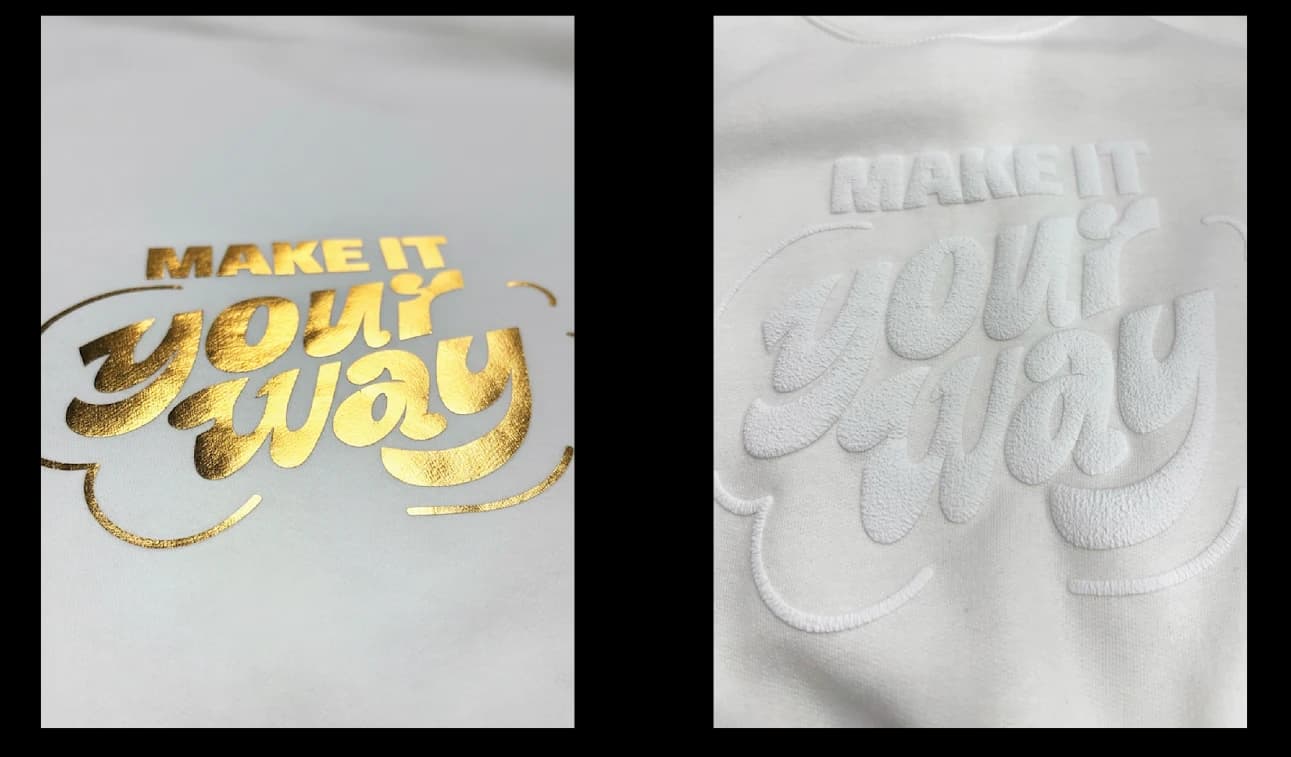
Metallic print is a design cut or printed from a specialty vinyl and heat-pressed onto the item. The material is what you are buying: it brings a physical property — height, sparkle, shine — that no flat ink can imitate, and none of it shows in a flat on-screen preview. The surface is a smooth mirror-like foil — gold, silver or a coloured metallic — that shifts and catches light as the item moves.
- Minimum line thickness
- 21 px (1.8 mm)Thinner material tears during cutting
- Minimum gap between elements
- 18 px (1.5 mm)Needed to weed cleanly
- Minimum text height
- 77 px (6.5 mm)
- Maximum text height
- 3449 px (292 mm) / 826 pt
- File formats
- PNG, SVGTransparent background
- Best for
- Bold shapes and lettering
Cut, not printed
The metallic vinyl is a sheet material. A blade cuts your design out of it, the surrounding waste is pulled away by hand — a step called weeding — and what is left is pressed onto the item. Nothing is printed, so the finish is uniform across the whole design and every part of it is the same colour.
That process is what sets the minimums. A stroke thinner than 21 px (1.8 mm) tears as the blade passes through it, and a gap narrower than 18 px (1.5 mm) cannot be picked out by hand without lifting the parts you wanted to keep.
Designing for weeding
Weeding is the constraint most designs run into. Every enclosed space in your artwork — the middle of an O, the gap inside an A, the space between two tight letters — has to be removed individually. Small counters and tight interletter spacing turn a two-minute job into a fiddly one and raise the odds of a torn edge.
Text at 77 px (6.5 mm) or taller in a medium-to-bold face weeds reliably. Below that, or in a fine face with delicate counters, the internal shapes stop surviving the process.

One colour, one finish
Because the design is cut from a single sheet, the whole of it is the same metallic vinyl. Multi-colour artwork, gradients and photographs are not what this method does — it does one bold shape, or one line of lettering, in a finish that catches light in a way flat ink never will.
Designs that lean into that read best: a strong monogram, a piece of display lettering, a simple emblem. Complexity works against both the material and the eye.
Do this, not that
Do
- Keep every stroke at least 21 px (1.8 mm) thickThinner material tears as the blade cuts it.
- Leave at least 18 px (1.5 mm) between elementsAnything tighter cannot be weeded without lifting the parts you want to keep.
- Set text at 77 px (6.5 mm) or taller in a medium-to-bold faceThe enclosed spaces inside letters have to be weeded out by hand.
- Design one bold shape rather than a busy compositionThe whole design is cut from one sheet in one finish — simplicity is what suits it.
Avoid
- Gradients, photographs and multi-colour artworkThe design is cut from a single sheet of one material; there is no second colour to cut.
- Fine scripts with tight, small countersEvery enclosed space must be weeded by hand, and small ones tear.
Common questions
- What is the minimum line thickness for metallic print?
- 21 px (1.8 mm). The design is cut from sheet material with a blade, and anything thinner tears as the blade passes through it rather than cutting cleanly.
- Can metallic print reproduce a multi-colour design?
- No. The design is cut from a single sheet of metallic vinyl, so the entire design is one colour and one finish. Gradients and photographs are not possible — this method is for bold single-colour shapes and lettering.
- What is weeding, and why does it affect my design?
- Weeding is the manual step of pulling away the waste material around and inside the cut design. Every enclosed space — the middle of an O, the gap inside an A — is removed by hand, so counters smaller than about 18 px (1.5 mm) cannot be removed without damaging the parts you want to keep.
- Will the preview show the finish?
- No. The on-screen preview shows flat colour, so it shows placement and shape but not how the material catches the light. That reflectivity is the point of the finish and is exactly what a flat image cannot show — order a sample if you need to see it first.
Products made this way

Related methods
How we know this
- Supplier heat-transfer-vinyl design guidelines and reference photography — verified 2026-08-15